
Get a tretinoin prescription online
*Average online dermatologist response time from July-September 2026: 18.6 hours
- Board-certified dermatologists
- No medication subscriptions
- Choice of generic or customized formulas
Tretinoin is commonly prescribed as part of treatment for the conditions below.
Available strengths::
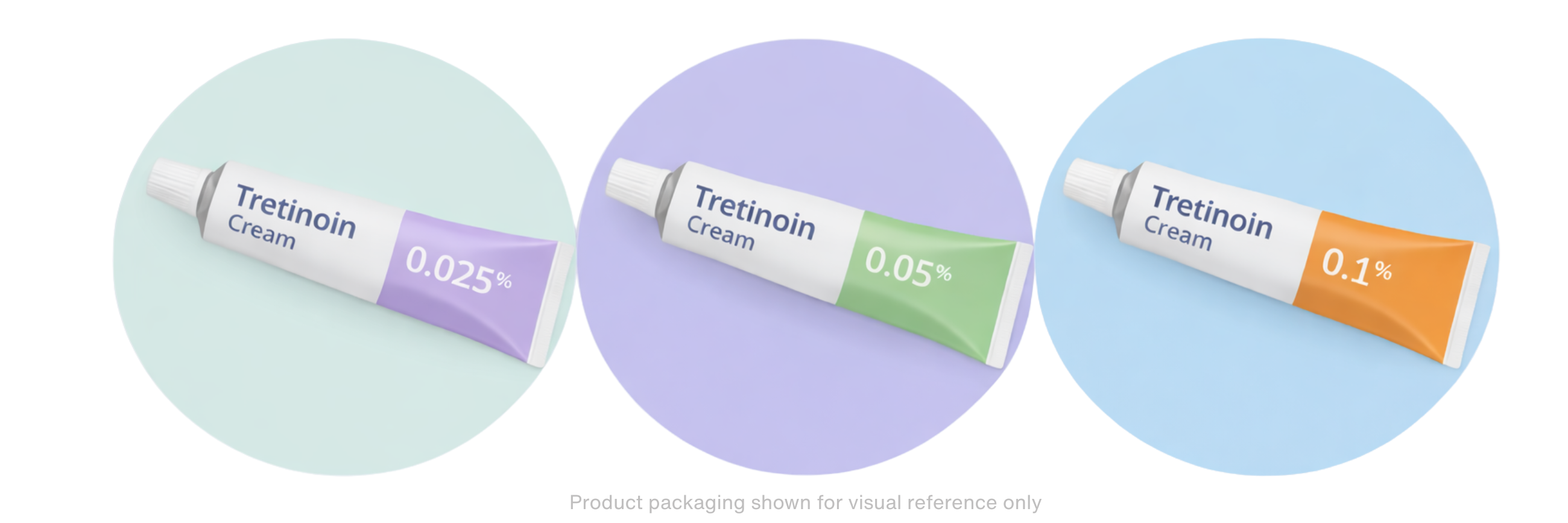
Tretinoin 0.025% | Tretinoin 0.05% | Tretinoin 0.1%


How to get tretinoin online?
Tretinoin is prescription-only in the US, so you need a prescription before you can buy it. The quickest way is an online consultation with a board-certified dermatologist licensed in your state. You don’t need a video call. If tretinoin is right for your skin, your prescription is sent to the pharmacy you choose, usually within 24–48 hours.

Submit your skin concern
Answer a short medical questionnaire and upload a few photos of your skin. It takes about 5 minutes, with no video call needed.

Dermatologist review
A board-certified dermatologist licensed in your state reviews your case. Average response time is less than a day.

Get your treatment plan
If tretinoin suits your skin, you’ll receive a prescription for generic, branded or customized tretinoin. Pick it up locally or have it delivered.
Tretinoin treatment options
You can request FDA-approved tretinoin or a customized tretinoin formula. Your dermatologist will recommend what’s best for your skin.

FDA-approved tretinoin
You can choose generic or brand-name tretinoin, which can be filled at any pharmacy nationwide. FDA-approved tretinoin has been reviewed for safety, effectiveness and quality, and has been used in dermatology for over 50 years.
- Tretinoin 0.025% (Generic Retin-A®)
- Tretinoin 0.05% (Generic Retin-A®)
- Tretinoin 0.1% (Generic Retin-A®)
- Retin-A Micro® (Tretinoin microsphere gel)
- Altreno® (Tretinoin lotion)
- Refissa® (Tretinoin cream)
Prescribed only if medically appropriate. Your dermatologist decides which product and strength fits your skin.

Customized tretinoin formulas
Customized formulas combine tretinoin with other active ingredients in one product tailored to your skin. They’re prepared by our trusted partner, Foothills Pharmacy, and delivered to your door. Most formulas are $48.99 with delivery included.
- Niacinamide
- Azelaic acid
- Hydroquinone
- Kojic acid
- Ascorbic acid
- Clindamycin
- Topical spironolactone
- Hydrocortisone
- Pracasil plus
Compounded medications are not reviewed by the FDA for safety or efficacy.

How does Miiskin compare to other online services for tretinoin?
Most online skincare services offer tretinoin only in their own compounded formulas, sold by subscription. Here’s how Miiskin compares on the things that matter when you’re getting a tretinoin prescription online.
Swipe to compare →
| Feature | Miiskin | Nurx | Agency | Hers | Curology |
|---|---|---|---|---|---|
| Provider type | Board-certified dermatologist | Physician, NP or PA | Physician, NP or PA | Physician or NP | Physician, NP or PA |
| Choose your dermatologist | Yes | No | No | No | No |
| Generic (FDA-approved) tretinoin | Yes | Yes | No* | No* | No* |
| Customized tretinoin formulas | Yes | Yes | Yes | Yes | Yes |
| Tretinoin strengths | 0.025%, 0.05%, 0.1% or custom | 0.025%, 0.05%, 0.1% | Custom only | Custom only, up to 0.09% | Custom only |
| Choice of pharmacy | Yes | No | No | No | No |
| Subscription required | No | Yes** | Yes | Yes | Yes |
*Tretinoin is offered only in compounded custom formulas. Compounded medications are not reviewed by the FDA for safety or efficacy.
**Advertised as “no subscription needed,” but medication ships and is billed automatically unless paused or canceled.
Comparison based on information published on each service’s website, October 2026.

What is tretinoin?
Tretinoin (generic version of Retin-A) is a topical prescription medication widely used by dermatologists to treat acne, hyperpigmentation, wrinkles and sun damage1.
Tretinoin works by accelerating the lifecycle of skin cells and boosting new collagen formation. It belongs to a family of synthetic and natural compounds called retinoids that are derived from Vitamin A2.
Benefits of tretinoin

Stimulates collagen for firmer skin

Reduces fine lines and wrinkles

Smooths skin texture and tone

Fades dark spots and discoloration

Unclogs pores and reduces breakouts

Prevents future acne formation
What is tretinoin cream or gel used for?
Tretinoin is used by dermatologists for the treatment of:

Acne and acne scars

Facial wrinkles

Skin roughness

Hyperpigmentation3
Brand names of tretinoin gels or creams
- Retin – A
- Altreno
- Atralin
- Avita
- Refissa
- Renova
- Tretin – X
- Retin – A micro
Tretinoin explained
How does tretinoin work?
Tretinoin stimulates cell renewal in the epidermis, enhancing the cell layer, reducing pigmentation and normalizing sun-damaged cells4.
Tretinoin also works in the dermis promoting the production of collagen and elastin thickening the dermal layer and making the skin appear more plump5.
According to multiple research, tretinoin gels and creams are a safe and effective therapeutic modality for the long-term treatment of acne and photoaging.6 78

Most common tretinoin strengths prescribed

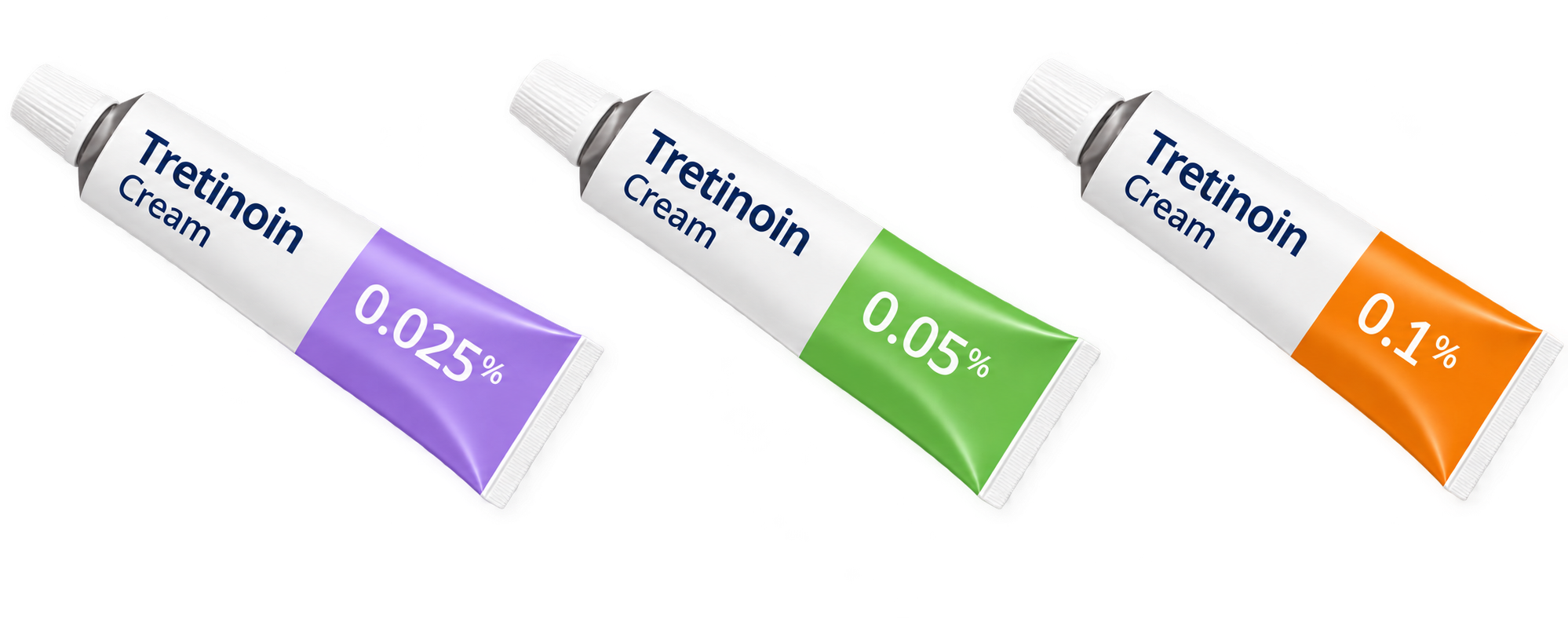
Tretinoin Cream 0.025%
Tretinoin cream at 0.025% concentration is a gentler option, often recommended for patients new to tretinoin or those with sensitive skin. Its lower strength allows for a gradual introduction to tretinoin, reducing the chance of irritation. It’s commonly used for mild concerns such as fine lines, uneven skin tone, and mild acne.

Tretinoin Cream 0.05%
Tretinoin cream 0.05% works faster and produces more visible results than the 0.025% cream. It’s a moderate-strength option suitable for addressing more prominent signs of aging, moderate acne, and persistent hyperpigmentation. Although it carries a higher risk of side effects like dryness, following your doctor’s guidance can help manage any reactions and maximize its effectiveness.

Tretinoin Cream 0.1%
Tretinoin cream 0.1% is considered high-strength and is typically reserved for more intense treatment needs. It is often recommended for individuals with more severe skin concerns, such as deep wrinkles, pronounced signs of aging, or stubborn acne that requires stronger intervention.
Still not sure which strength fits your skin?
Our tretinoin strengths guide breaks down every concentration in detail and explains when it’s the right time to move up.
Warnings, side effects and purging
Warning and precautions when using tretinoin creams or gels
This medication should only be used under medical supervision and it is advised that women use effective contraception when using tretinoin.
Tretinoin is considered teratogenic, and therefore it cannot be used by women who want to become pregnant, are pregnant, or are breastfeeding because it may cause serious harm to the fetus13 14.
Tretinoin is likely to make your skin more sensitive to sunlight so you should apply sunscreen with SPF 50 factor every morning while using this product and reapply every two hours when outdoors.
Tretinoin may cause skin irritation when you first start using it, follow the precise instructions of your healthcare provider to minimize unwanted side effects.
Do not combine tretinoin with other acne or pigmentation medications, unless indicated by your doctor.
Side effects of tretinoin
- Redness
- Peeling
- Itching
- Burning/Stinging
- Dryness15
What is the tretinoin purge?
The tretinoin purge (also known as tretinoin uglies) is a very common skin reaction that occurs when a patient uses tretinoin for the first time.

How to get started once tretinoin is prescribed?
You should always follow the precise instructions of your healthcare provider, because your treatment plan will depend on your skin condition and your skin type. However, as a general rule, if you have never used tretinoin, here is a good way to start.
- First 2 to 4 weeks:
Apply tretinoin .025% two nights per week in the evenings - Following 2 weeks:
Apply tretinoin every other night - After 6 to 8 weeks of use:
If your skin tolerates the product well, apply the product every night
It is also important to find a balance that is right for you. Your skin may not tolerate the application of tretinoin every day even after weeks of use and you may notice that your skin improves by applying tretinoin every other day instead of daily.
How to use Tretinoin correctly
Watch this 2-minute video where doctor Anna Chacon, board-certified dermatologist in the Miiskin network, explains how to use tretinoin the proper way to minimize the potential of irritation.
Click to read video transcript
How to Use Tretinoin
– Start with a gentle cleanser.
– Wash your face with lukewarm water and pat dry with a soft towel.
– Always make sure your skin is completely dry before applying tretinoin — wait about 15 to 20 minutes. This helps minimize irritation.
– Before applying tretinoin, always start with a gentle, non-comedogenic moisturizer. This helps protect your skin barrier and reduces dryness and peeling.
– Next, squeeze out a pea-sized amount — that’s really all you need for your entire face. Dot the tretinoin across your forehead, both cheeks, nose, and chin. Then gently spread it evenly over your entire face.
– Avoid the corners of your mouth, the creases around your nose, and the delicate skin around your eyes — these areas are more prone to irritation.
– Apply an additional layer of moisturizer across the face and neck. This is optional but recommended, especially if you have sensitive skin. You can also use a hyaluronic serum instead of a moisturizing cream.
– Remember, tretinoin takes time to work. You may not see results for several weeks, but consistency is key.
– Tretinoin requires a prescription from a dermatologist. If you are interested in getting a personalized tretinoin formula — with up to three additional ingredients for your skin — I am here to help.
Click the link to start your consultation today.
What ingredients can be safely combined with tretinoin?
 Sunscreen SPF 50
Hyaluronic acid
Non-greasy moisturizer
Azelaic acid
Niacinamide
Peptides
Ceramides
What ingredients should not be combined with tretinoin?
- Benzoyl peroxide*
- Glycolic acid*
- Lactic acid*
- Salicylic acid*
- Retinol
- Tazarotene
- Trifarotene
- Adapalene
*Unless instructed by a dermatologist
References:
1https://www.ncbi.nlm.nih.gov/books/NBK557478/
2https://www.ncbi.nlm.nih.gov/pmc/articles/PMC9112391/
3https://www.ncbi.nlm.nih.gov/books/NBK557478/
4https://www.ncbi.nlm.nih.gov/books/NBK557478/
5https://www.ncbi.nlm.nih.gov/pmc/articles/PMC9112391/
6https://www.ncbi.nlm.nih.gov/pmc/articles/PMC9112391/
7https://jamanetwork.com/journals/jamadermatology/article-abstract/553009
8https://www.ncbi.nlm.nih.gov/pmc/articles/PMC5574737/
9https://link.springer.com/article/10.2165/00002512-199506060-00008
10https://www.ncbi.nlm.nih.gov/pmc/articles/PMC3225141/
11https://pubmed.ncbi.nlm.nih.gov/16045694/
12https://www.ncbi.nlm.nih.gov/pmc/articles/PMC3225141/
13https://rarediseases.info.nih.gov/diseases/517/fetal-retinoid-syndrome
14https://pubmed.ncbi.nlm.nih.gov/26897386/
15https://www.ncbi.nlm.nih.gov/pmc/articles/PMC9112391/
 Want a tretinoin prescription?