
Aklief (trifarotene) vs tretinoin: What is best for acne?
This article compares Aklief with tretinoin highlighting their various characteristics, different ways of action, and how they improve the skin.

Table of Content:
Similarities | Differences | Price | What is best for acne? | What is best for pigmentation? | What is best for anti-aging? | Who can use them? | Who should not use them?
Trying to decide between Aklief and tretinoin but not sure which one will actually work best for your skin?
You’re not alone. Both are powerful prescription retinoids used to treat acne and improve skin tone, but they differ in strength, tolerability, their price and how they target other skin concerns (like hyperpigmentation). Choosing the wrong one can mean more irritation, slower results, or giving up too early.
Tretinoin has long been considered the gold standard, while Aklief (trifarotene) is a newer, more targeted retinoid designed specifically for acne-prone skin. But the “best” option depends on your skin type, sensitivity, budget and goals.
That’s where a personalized approach matters. A customized treatment plan, guided by a dermatologist, helps you choose not just the right ingredient, but the right strength and routine, so you can get results without unnecessary side effects.
With Miiskin, you can get a prescription for both tretinoin or Aklief online (something most telehealth services don’t offer). Your treatment is tailored to your skin and delivered directly to your door.
Similarities between Aklief (trifarotene) and tretinoin
Aklief (trifarotene) and tretinoin are both topical prescription retinoids commonly used to treat acne and hyperpigmentation (melasma)1. This means they can only be purchased with a doctor’s prescription.
Besides, both medications belong to a class of medications called retinoids, which are derivatives of vitamin A known for their ability to influence skin cell turnover, unclog pores, and promote a smoother complexion2.
It is important to highlight that applying these topical medications at night and the concurrent use of sunscreen in these treatments is essential, as stimulating cell turnover makes the skin more prone to sunburn.
Acne
Both Aklief and tretinoin are FDA-approved for the treatment of acne. They work by targeting multiple factors involved in acne development, including reducing inflammation, preventing clogged pores, and promoting the shedding of dead skin cells3 4 .
Hyperpigmentation
Tretinoin is sometimes used off-label to treat post-inflammatory hyperpigmentation (PIH), including dark spots that can develop after acne. Aklief (trifarotene) is not FDA-approved for PIH, but studies suggest it may help improve acne-associated hyperpigmentation. Both retinoids promote skin cell turnover, which may help gradually improve uneven pigmentation and skin tone over time5 6 .
Comedolytic properties
Comedones, including blackheads (open comedones) and whiteheads (closed comedones), are common acne lesions. Both Aklief and tretinoin have comedolytic properties: they help normalize the shedding of skin cells within hair follicles, which can help clear existing comedones and prevent new ones from forming7 8
Cell turnover stimulation
Both Aklief and tretinoin are topical retinoids that regulate the growth and differentiation of skin cells and help normalize the shedding of cells within hair follicles. These effects help prevent clogged pores and may also contribute to improvements in skin texture and uneven pigmentation over time.9 10 .
Increased need for sun protection
While using Aklief or tretinoin, it is important to protect treated skin from excessive exposure to sunlight and other sources of ultraviolet (UV) light. Both medications can cause irritation, and sun exposure may further irritate treated skin. Using a broad-spectrum sunscreen, wearing protective clothing, and limiting excessive sun exposure can help protect the skin during treatment.
May cause irritation or skin purging
Both Aklief and tretinoin can cause purging or local skin irritation, particularly during the first few weeks of treatment. Common side effects include redness, dryness, peeling, burning, and stinging. These effects often improve as the skin adjusts to treatment. Following the prescribed treatment schedule and using a suitable moisturizer can help reduce irritation.
Use during pregnancy and breastfeeding
Aklief (trifarotene) and tretinoin are generally not recommended during pregnancy because of the potential risk to the developing fetus associated with retinoids. Women who are pregnant, planning to become pregnant, or breastfeeding should discuss the use of these medications with their healthcare provider.

All About Tretinoin
Tretinoin vs Aklief: the differences
Aklief (trifarotene) and tretinoin are both prescription topical retinoids used to treat acne, but they are not identical. They differ in their active ingredient, how they interact with retinoid receptors in the skin, FDA-approved uses and age ranges, available formulations, tolerability, and cost.
Aklief is a newer, fourth-generation retinoid that selectively targets retinoic acid receptor gamma (RAR-γ), the most abundant retinoic acid receptor in the skin. It is FDA-approved to treat acne vulgaris in patients 9 years and older and has been specifically studied for acne affecting both the face and trunk, including the chest, shoulders, and back.
Tretinoin is an older and much more extensively studied topical retinoid. Depending on the formulation and strength, it is FDA-approved for acne, and certain formulations are also approved to help reduce fine facial wrinkles as part of a comprehensive skincare and sun-protection program. Tretinoin is available in several formulations and strengths, including generic options.
The approved age for tretinoin depends on the specific product and formulation. Some topical tretinoin products are approved for treating acne in patients 10 years and older, while others have different pediatric labeling or have not been established as safe and effective in younger age groups. In comparison, Aklief has a clearly established FDA-approved indication for acne in patients 9 years and older.
Both medications can cause similar local side effects, such as dryness, redness, peeling, burning, and irritation, particularly when treatment is first started. Individual tolerability varies, so one retinoid may work better for a particular patient than another.
Cost is another important difference. Aklief is a branded medication and can be considerably more expensive than generic tretinoin, although the amount a patient actually pays depends on insurance coverage, pharmacy pricing, and available discounts. For many patients, tretinoin may therefore be a more affordable and well-established option. However, Aklief may be preferable in certain situations, particularly when treating acne on larger areas of the body or when recommended based on a patient’s individual response and tolerability.
How to get a prescription for tretinoin or Aklief?
You can get a prescription for Tretinoin or Aklief by having an online consultation with a dermatologist via Miiskin.
Since pricing and provider quality can differ a lot between platforms, it’s a good idea to compare a few online acne treatment services before choosing one.
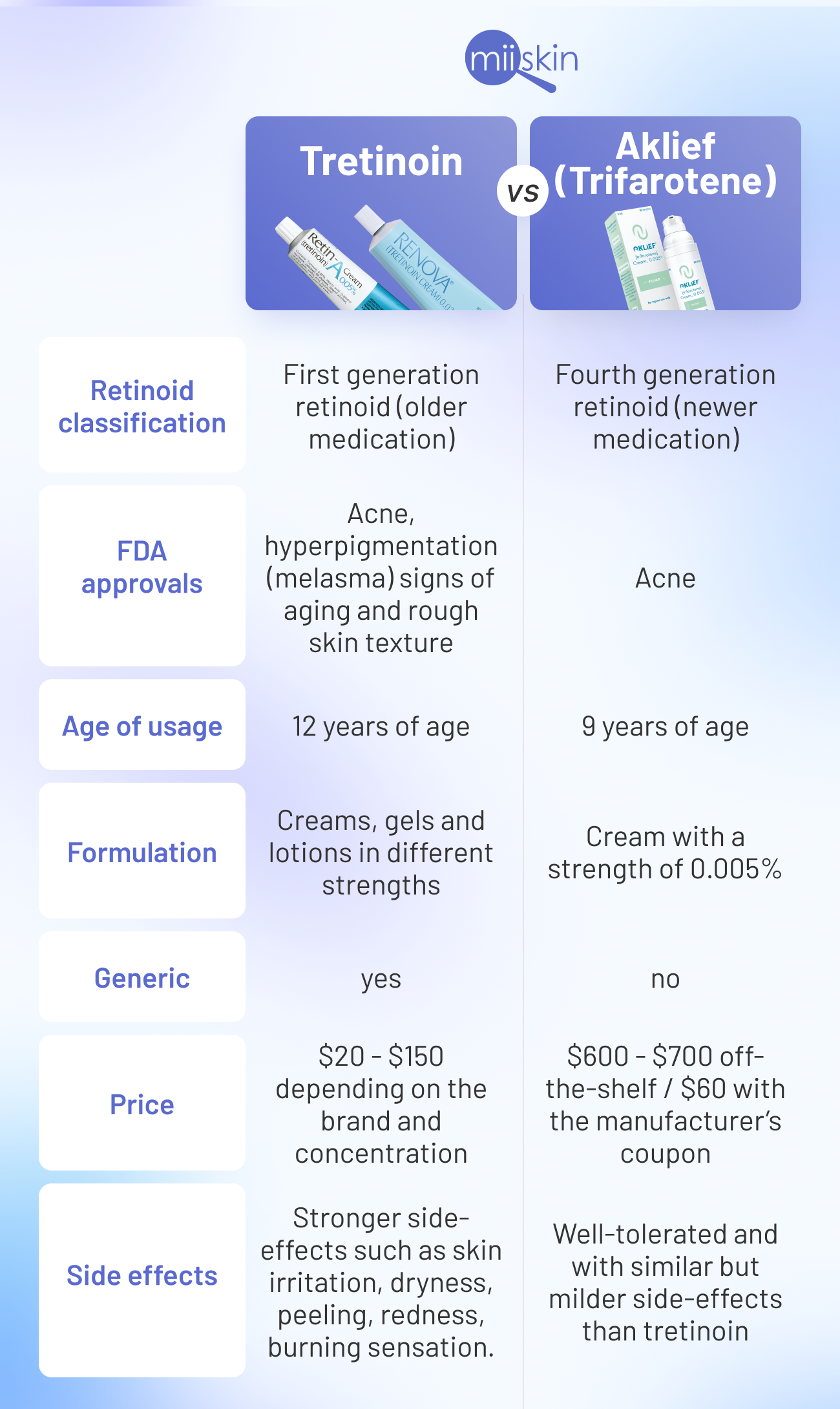
Retinoid classification
Aklief (Trifarotene) is a fourth-generation retinoid (medication released in 2019) designed to target retinoic acid receptor gamma, which is found in the skin. This selective targeting potentially reduces side effects associated with impacting other retinoic acid receptors.
Tretinoin on the other hand is a first-generation retinoid (medication that was introduced in the 70’s) that binds to multiple retinoic acid receptors and has been widely used to treat several skin conditions11.
FDA approvals
Aklief (trifarotene) is FDA-approved for the treatment of acne in people 9 years and older. Tretinoin is also FDA-approved for acne, although the approved age varies by product. In addition, certain tretinoin formulations are FDA-approved to improve fine facial wrinkles and other signs of sun-damaged skin. The exact approved uses depend on the specific tretinoin product.12
Age of usage
Most tretinoin formulations (with the exception of Altreno) should only be used by patients 12 years of age and older. On the other hand, Aklief can be used by patients as young as 9 years of age13.
Formulation
Aklief is available only as a topical cream formulation. On the other hand you can find tretinoin creams, gels, and lotions, with different strengths designed for specific skin types.
Generic
Since Aklief is a newer medication, there isn’t a generic formulation available in the market, on the other hand there are multiple brands and generic formulations available for tretinoin.
Price
The off-the-shelf price for Aklief without any coupon is between $600 – $700 for a 45 gr. tube. However, the manufacturer of Aklief offers a patient coupon that allows patients to buy Aklief for $60. The price of tretinoin ranges between $20 – $150 depending on the brand and concentration*.
*The price range listed here is just an estimation. Medication prices may vary depending on the state and the pharmacy selected. Miiskin is not responsible and cannot influence the price of the medication as it is independent from these entities.
Side Effects
Aklief (Trifarotene) is formulated to target the retinoic acid receptor gamma potentially minimizing the potency of its side effects which include skin dryness, irritation, and redness. Clinical studies have shown that trifarotene (Aklief) is generally well-tolerated, and it causes less skin irritation compared to tretinoin14.
Tretinoin can cause side effects such as skin dryness, peeling, redness, and increased sensitivity to sunlight, especially during the initial stages of treatment. That is why at the beginning of the treatment, it is recommended to alternate and not use it every night.
Other tretinoin topics
Everything you need to know about using tretinoin for wrinkles and anti-aging.
Have you heard about the so-called tretinoin purge? When should you expect it to come, how to minimize the symptoms, and how long will it last.
What is the difference between Altreno and Retin-A? Discover the differences between these two tretinoin brands.
Tazarotene vs tretinoin: What are the differences between these two retinoids and learn which one is better for your skin?
This article is also available in Spanish: Retin-A ó Aklief ¿Cuál es mejor para el acné y la hiperpigmentación?
Interested in learning more tretinoin?
All you need to know about tretinoin cream
How to use tretinoin? A dermatologist's guide for proper use
What are the most common tretinoin strengths?
Does tretinoin expire?
What is different about tretinoin 0.025%
What is different about tretinoin 0.05%
What is different about tretinoin 0.1%
Tretinoin vs Aklief
Tretinoin vs Tazarotene
Tretinoin vs Adapalene
Tretinoin vs Retinol
Article References:
https://www.ncbi.nlm.nih.gov/pmc/articles/PMC9166940
https://www.ncbi.nlm.nih.gov/pmc/articles/PMC8750127/
https://www.ncbi.nlm.nih.gov/books/NBK557478/

The 12 most used acne treatments
Discover the top 12 topical acne treatments to help you and your doctor in making the best plan for your acne.




 Not sure what you need?