Best hair loss treatments according to a dermatologist
Dr. Ryan Trowbridge, dermatologist, talks about the best dermatologist-recommended treatments for hair loss in men and women that help slow hair loss and support regrowth.
Table of Content:
Best hair loss treatments for men | Finasteride | Dutasteride | Minoxidil | Explore treatment options | Best hair loss treatments for women | Spironolactone | Minoxidil | Explore treatment options | FAQ

Our commitment to producing high-quality content:
The information presented in this article is based on scientific research and the professional advice of our Content Medical Reviewers, who are experts in the field of Dermatology. How we write our content →
Hair loss can feel overwhelming — whether it’s gradual thinning, a widening part, or sudden shedding that seems to come out of nowhere. With countless products, supplements, and “miracle cures” on the market, it’s hard to know what actually works and what’s just clever marketing. That’s where expert guidance matters.
In this article, Dr. Rayan Trowbridge, board-certified dermatologist and hair loss expert breaks down the best hair loss treatments for men and women. From FDA-approved medications to off-label and compounded medications, you’ll learn which options are available to you, who they’re best suited for, and what kind of results you can realistically expect. If you’re looking for a tailor-made solution to support hair growth journey and slow further loss, this guide will help you make informed decisions with confidence.
When to consult a dermatologist for hair loss?
When it comes to hair loss, it is very important to start treatment as early as possible. So, if you notice more hair loss than the usual, it is best to consult a dermatologist and start treatment as soon as possible.
Via Miiskin you can request many oral and topical formulas for your hair concerns, simply select Foothills as your preferred pharmacy and order your treatment as soon as you get a prescription issued. Consultation price is $39-$59 and you will get your prescription if medically adequate in 1-2 days.
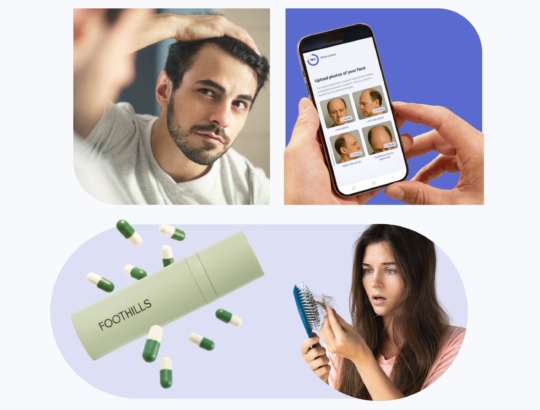
Best hair loss treatments for men
Dr. Trowbridge says that there are three oral medications that are widely prescribed for hair loss in men: Finasteride, dutasteride and minoxidil.
Finasteride
Finasteride is an FDA-approved oral medication for male pattern hair loss. It works by blocking the enzyme 5-alpha reductase type II, which converts testosterone into dihydrotestosterone (DHT) — the hormone responsible for shrinking hair follicles in androgenetic alopecia. By lowering DHT levels, finasteride helps slow hair loss and, in many cases, may promote regrowth.
What is finasteride suitable for?
Finasteride is suitable for men with mild to moderate androgenetic alopecia. It is taken as a once-daily tablet and is most effective when started early. It is not approved for use in women for hair loss and should not be used during pregnancy, but is commonly used off-label.
Price of finasteride tablets via Miiskin
The price of 30 finasteride tablets available via Miiskin from Foothills pharmacy is $24.99
Pros
- FDA-approved for male pattern hair loss
- Reduces DHT levels
- Slows progression of hair loss
- May stimulate regrowth
Cons
- Must be taken continuously to maintain results
- Prescription required
- Not FDA approved for women (off-label use is common)
- Possible sexual side effects
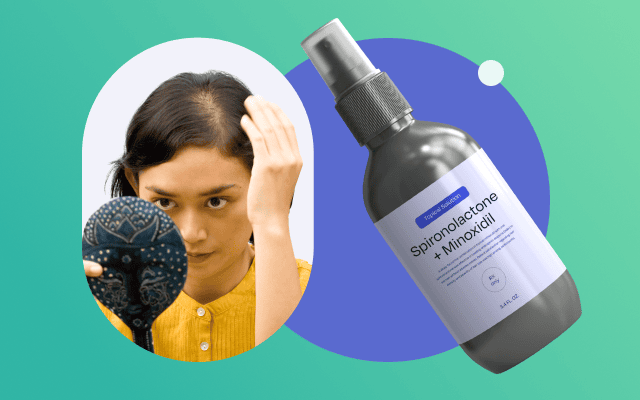
Understanding Hair Loss Treatments
Dutasteride
Dutasteride is an oral medication that is used off-label in the treatment of hair loss. It works by blocking both type I and type II 5-alpha reductase enzymes, leading to a more significant reduction in DHT compared to finasteride. It is FDA-approved for benign prostatic hyperplasia, but it is commonly prescribed for hair loss.
What is dutasteride suitable for?
Dutasteride may be suitable for men with androgenetic alopecia who have not responded adequately to finasteride. It is taken once daily and requires a prescription.
Price of dutasteride tablets via Miiskin
The price of 30 dutasteride tablets available via Miiskin from Foothills pharmacy is $24.99
Pros
- More potent DHT suppression than finasteride
- May be more effective than finasteride
- Convenient once-daily dosing (same as finasteride), and can be dosed less than daily (weekly, every other day, etc)
Cons
- Off-label for hair loss
- Prescription required
- Possible increase in potential sexual side effects compared to finasteride
Oral minoxidil
Oral minoxidil was originally developed as a blood pressure medication. It is often prescribed by dermatologists off-label at a low dose for hair loss. It works by improving blood flow to hair follicles and prolonging the hair growth phase.
What is oral minoxidil suitable for?
Low-dose oral minoxidil may be suitable for men and women with androgenetic alopecia, especially those who cannot tolerate topical minoxidil or prefer a pill.
Price of oral minoxidil tablets via Miiskin
The price of 30 oral minoxidil tablets available via Miiskin from Foothills pharmacy is $24.99
Pros
- Convenient oral alternative to topical minoxidil
- Suitable for men and women
- Can improve hair density and reduce shedding over the long term
Cons
- Off-label for hair loss
- Prescription required
- May cause increased body hair (hypertrichosis)
- Possible side effects include fluid retention or changes in blood pressure
Topical minoxidil
Topical minoxidil is an FDA-approved treatment for hair loss that is applied directly to the scalp. Originally developed as an oral blood pressure medication, minoxidil was later formulated as a topical solution or foam after researchers observed its hair growth–stimulating effects. It works by increasing blood flow to the hair follicles and prolonging the anagen (growth) phase of the hair cycle, helping to reduce shedding and promote thicker hair growth.
What is topical minoxidil suitable for?
Topical minoxidil is suitable for both men and women with androgenetic alopecia. It is often recommended as a first-line treatment and may also be used alongside other therapies such as oral medications or compounded topical treatments.
Price of topical minoxidil via Miiskin
The price of topical minoxidil via Miiskin varies depending on the additional ingredients it is compounded with. Topical formulations for hair care purchased via Foothills pharmacy are $48.99, $58.99 and $68.99.
Pros
- FDA-approved for hair loss
- Available in solution or foam formulations
- Suitable for men and women
- May improve hair density and reduce shedding
Cons
- Requires daily (women) or twice daily (men), ongoing application
- May cause initial shedding
- Can lead to scalp dryness or irritation
- Results typically take several months to become noticeable
Oral compounded medications for hair care
Dr. Trowbridge says that in addition to these 3 medication, dermatologists often prescribe compounded medications that are fitted for a patient’s needs, for example:
- Compounded oral minoxidil with finasteride
- Compounded oral minoxidil with dutasteride
Important: Compounded medications are not reviewed by the FDA for safety or efficacy.
Topical compounded medications for hair care
Dr. Trowbridge also explains that there are over 40 topical compounded medications that the dermatologists in the Miiskin network can prescribe via Miiskin for a patient’s individual needs. These topical medications may include several ingredients such as minoxidil, finasteride, dutasteride, spironolactone, latanoprost, tretinoin, salicylic acid and ketoconazole.
Important: Compounded medications are not reviewed by the FDA for safety or efficacy.
Want to explore the different formulas available through Miiskin?
If you’re not quite ready to make a decision yet, that’s completely okay. It can be helpful to review the available formulas, compare ingredient lists, and see pricing details before choosing the option that feels right for you. Take your time exploring the hair care formulas to better understand what each formula offers and how it may fit your skincare goals.
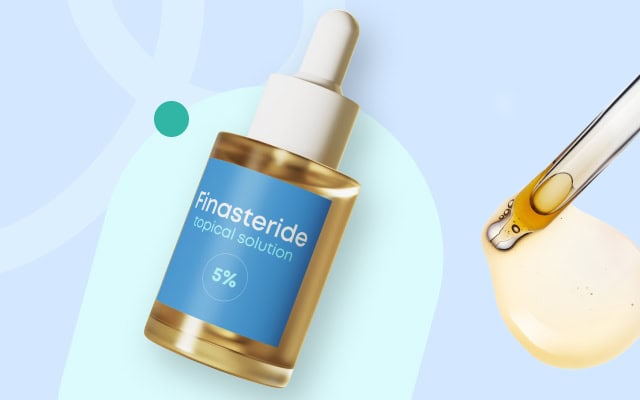
Medications for Hair Loss: What You Should Consider
Best treatment for hair loss in women
Spironolactone
Spironolactone is an oral anti-androgen medication commonly used to treat hormonal acne and fluid retention. For hair loss, it works by blocking androgen receptors and reducing the effect of DHT on hair follicles.
What is spironolactone suitable for?
Spironolactone is primarily prescribed for women with female pattern hair loss, especially when there are signs of hormonal imbalance. It is not typically used in men due to the risk of feminizing side effects.
Pros
- Effective for hormonal hair loss in women
- May also improve acne
- Helps reduce further thinning
Cons
- Prescription required
- Not safe during pregnancy
- May cause menstrual irregularities or breast tenderness
- May require monitoring of potassium levels if older than 50 or other medical issues are present
Oral Minoxidil
Oral minoxidil was initially developed to treat high blood pressure. Today, dermatologists commonly prescribe it off-label in low doses to help manage hair loss. It works by increasing blood circulation to the hair follicles and extending the anagen (growth) phase of the hair cycle.
What is oral minoxidil suitable for?
Low-dose oral minoxidil may be appropriate for both men and women with androgenetic alopecia, particularly individuals who do not tolerate topical minoxidil well or prefer the convenience of an oral medication.
Price of oral minoxidil tablets via Miiskin
The cost of 30 oral minoxidil tablets available through Miiskin from Foothills Pharmacy is $24.99.
Pros
- Easy-to-use oral alternative to topical formulations
- Suitable for both men and women
- May increase hair density and decrease shedding
Cons
- Prescribed off-label for hair loss
- Requires a prescription
- Can cause excess hair growth (hypertrichosis)
- Potential side effects include fluid retention and blood pressure changes
Topical Minoxidil
Topical minoxidil is an FDA-approved medication applied directly to the scalp to treat hair loss. Although it was originally developed as an oral treatment for high blood pressure, its hair growth–promoting effects led to the development of topical formulations. It works by enhancing blood flow to the hair follicles and extending the anagen (growth) phase of the hair cycle, which can help slow shedding and encourage thicker hair growth.
What is topical minoxidil suitable for?
Topical minoxidil is appropriate for both men and women with androgenetic alopecia. It is commonly recommended as a first-line treatment and can also be used in combination with other therapies, including oral medications or customized topical compounds.
Price of topical minoxidil via Miiskin
The price of topical minoxidil via Miiskin varies depending on the additional ingredients it is compounded with. Topical formulations for hair care purchased via Foothills pharmacy are $48.99, $58.99 and $68.99.
Pros
- FDA-approved treatment for hair loss
- Comes in foam or solution forms
- Suitable for both men and women
- Can improve hair thickness and reduce shedding
Cons
- Must be applied consistently for ongoing benefit
- Temporary shedding may occur at the start of treatment
- May cause scalp irritation or dryness
- Visible results often take several months
Oral compounded medications for hair care
Dr. Trowbridge says that in addition to these 2 medication, dermatologists can also prescribe a compounded medication if it’s fit for a patient’s needs:
- Compounded oral minoxidil with spironolactone
Important: Compounded medications are not reviewed by the FDA for safety or efficacy.
Topical compounded medications for hair care
Dr. Trowbridge also notes that he can prescribe via Miiskin more than 40 different customized topical formulations tailored to each patient’s specific needs. These compounded treatments may contain a combination of ingredients such as minoxidil, finasteride, dutasteride, spironolactone, latanoprost, tretinoin, salicylic acid, and ketoconazole.
Important: Compounded medications are not reviewed by the FDA for safety or efficacy.
Want to explore the different formulas available through Miiskin?
If you’re not quite ready to make a decision yet, that’s completely okay. It can be helpful to review the available formulas, compare ingredient lists, and see pricing details before choosing the option that feels right for you. Take your time exploring the hair care formulas to better understand what each formula offers and how it may fit your skincare goals.
FAQ about hair loss treatments for men and women
What is the best topical hair loss treatment?
Dr. Trowbridge says that finasteride and topical minoxidil are the only FDA-approved topical treatment for hair loss. However, an approach he often takes is issuing a prescription for an oral or topical treatment tailored to a patient’s individual needs that includes ingredients such as minoxidil, finasteride, dutasteride, spironolactone, latanoprost, tretinoin, salicylic acid, and ketoconazole.
Important: Compounded medications are not reviewed by the FDA for safety or efficacy.
How long does it take to see results from hair loss medications?
Most hair loss treatments require consistent use for at least three to six months before noticeable improvement occurs, and full results may take up to 12 months. Early in treatment, some patients experience temporary shedding as weaker hairs fall out to make way for new growth. Patience and adherence are key, as stopping treatment usually leads to gradual reversal of benefits.
Do I need to take hair loss medication forever?
Hair loss medications generally need to be continued long term to maintain results. These treatments manage the underlying process, such as DHT sensitivity, rather than permanently curing it. If medication is discontinued, hair loss typically resumes within several months and any regrown hair may be lost.
Are hair loss treatments more effective when combined?
Combination therapy is often more effective than a single treatment alone. For example, pairing a DHT-blocking medication like finasteride with minoxidil can address both hormonal causes and hair growth stimulation. Dermatologists frequently tailor treatment plans based on the patient’s type of hair loss, severity, and overall health.
Is initial shedding normal when starting treatment?
Yes, temporary increased shedding can occur when starting treatments like minoxidil or finasteride. This happens because the hair cycle is shifting, and older hairs are being pushed out to allow new, stronger hairs to grow. While it can be alarming, this shedding phase is usually short-lived and a sign that the medication is working.
What is the most effective treatment for androgenetic alopecia?
For men, oral finasteride or dutasteride paired with topical or oral minoxidil is often considered one of the most effective evidence-based treatments. For women, options may include topical minoxidil, spironolactone, or low-dose oral minoxidil. Oral finasteride may also be effective. The “best” treatment depends on the individual’s sex, medical history, and treatment goals.
Can hair loss treatments completely restore lost hair?
Hair loss treatments are most effective at slowing progression and thickening miniaturized hairs rather than fully restoring long-lost hair. The earlier treatment is started, the better the outcomes tend to be. In advanced cases, surgical options like hair transplantation may be considered.
Are there natural alternatives to prescription hair loss medications?
Some supplements and natural remedies claim to support hair growth, but most lack strong scientific evidence compared to FDA-approved or dermatologist-prescribed treatments. While maintaining a balanced diet and addressing nutrient deficiencies can support overall hair health, they typically do not have consistent noticeable benefits for genetic hair loss.
Are hair loss medications safe for long-term use?
Many hair loss medications, such as finasteride and minoxidil, have been studied for long-term use and are generally considered safe when taken as prescribed. However, like all medications, they carry potential side effects, and patients should have regular follow-up with their healthcare provider to monitor for any concerns.
Can stress-related hair loss be treated the same way as pattern hair loss?
Stress-related hair loss (telogen effluvium) is managed differently from androgenetic alopecia. It often resolves once the triggering factor (typically a physical illness) such as the flu surgery, thyroid dysfunction, or anemia, and possibly emotional stress—is addressed. While medications like minoxidil can sometimes be used to support regrowth, identifying and correcting the underlying cause is the primary treatment approach. Many cases of remarkable hair loss recovery claimed on social media are probably telogen effluvium misdiagnosed as telogen effluvium.
When should I consult a dermatologist about hair loss?
You should consider seeing a dermatologist if you notice sudden shedding, patchy hair loss, scalp symptoms like itching or pain, or progressive thinning that concerns you. Early evaluation can help determine the type of hair loss and allow treatment to begin before significant follicle miniaturization occurs, improving the likelihood of successful outcomes.
Can women take finasteride or dutasteride for hair loss?
Finasteride and dutasteride are not FDA-approved for hair loss in women, but they may sometimes be prescribed off-label in select cases under specialist supervision. These medications lower DHT levels, which can contribute to female pattern hair loss in some patients. However, they are not safe during pregnancy due to the risk of birth defects in a male fetus, and women of childbearing potential must use strict contraception if prescribed. A dermatologist will weigh the potential benefits and risks before recommending these treatments.
Can men take spironolactone for hair loss?
Spironolactone is generally not prescribed orally for men with hair loss because it blocks androgen receptors and reduces the effects of male hormones, which can lead to unwanted side effects such as breast tenderness, breast enlargement (gynecomastia), and reduced libido. While it is commonly used in women with hormonal hair thinning, its hormonal effects make it unsuitable for most male patients. Men are typically treated with medications like finasteride or dutasteride instead, which decrease androgens in select tissues without blocking androgen receptors.
Can men and women take oral minoxidil for hair loss?
Low-dose oral minoxidil may be prescribed off-label for both men and women with hair loss, particularly those who cannot tolerate topical minoxidil or prefer a pill. It works by increasing blood flow to hair follicles and prolonging the growth phase of the hair cycle. Although generally well tolerated at low doses, it can cause side effects such as increased body hair, fluid retention, or changes in blood pressure, so it should only be taken under medical supervision.
What over the counter products are effective for hair growth?
Several over-the-counter (OTC) hair growth products may support hair health, though their effectiveness varies. Topical minoxidil remains the only FDA-approved and most well-studied option for both men and women, helping slow shedding and promote regrowth, and is available over the counter.
Ketoconazole shampoos may improve scalp health and offer very mild anti-androgen effects, while caffeine-based products and saw palmetto have limited evidence for supporting hair follicles. Hair vitamin supplements such as biotin, pumpkin seed oil, collagen, and multivitamins containing zinc, iron, or vitamin D in some cases may be beneficial but don’t reliably regrow hair unless significant underlying nutrient deficiencies are present. Essential oils like rosemary oil have shown very modest results in small studies. While these options can provide perceived benefits to individuals in select cases the lack of evidence for their effectiveness and possible complications like allergic reactions make them at best complementary therapies rather than primary solutions. However, emerging data can always shed light on the application of these treatments and possible effectiveness.
Article References:
https://pubmed.ncbi.nlm.nih.gov/9777765/
https://pubmed.gov/40345536
https://www.ncbi.nlm.nih.gov/books/NBK513329/
https://pmc.ncbi.nlm.nih.gov/articles/PMC9561294/
https://www.dermatologyadvisor.com/news/dutasteride-most-effective-monotherapy-androgenetic-alopecia-men/
https://pmc.ncbi.nlm.nih.gov/articles/PMC9650732/
https://consultqd.clevelandclinic.org/oral-minoxidil-offers-strong-results-against-alopecia
https://pmc.ncbi.nlm.nih.gov/articles/PMC10502763/
https://pmc.ncbi.nlm.nih.gov/articles/PMC10010138/
 Interested in getting a hair loss prescription?
Consult a dermatologist →